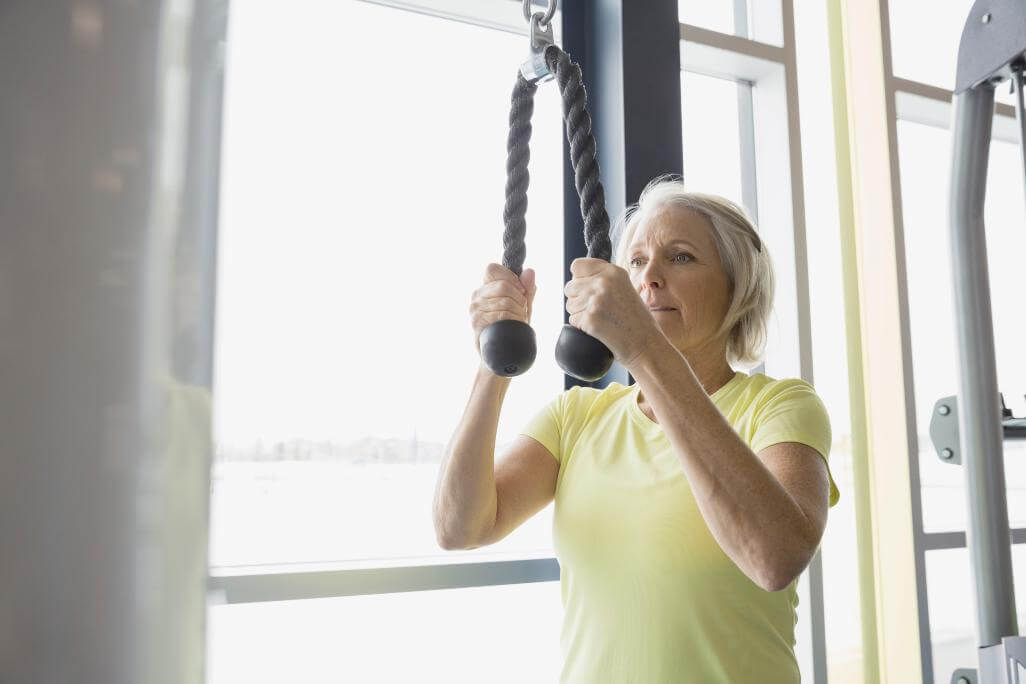
If you are in perimenopause or post-menopause and trying to figure out whether you need a completely different approach to training, the short answer is: not entirely, but some things do genuinely matter more now than they did before. The longer answer is worth understanding properly, because the way this conversation tends to go in popular wellness spaces oversimplifies in both directions. Either everything has to change or nothing does. Neither is quite right.
What perimenopause and menopause actually change is the context in which training happens. The hormonal environment shifts in ways that have real physiological consequences. Recovery capacity tends to be affected. Sleep quality often gets worse. Stress sensitivity can increase. The body’s relationship with muscle and bone changes in ways that make certain things more important than they used to be. None of this makes standard training advice useless. But it does mean that advice built around average recovery in stable conditions may need more adjustment at this life stage than at any other.
What actually changes
Oestrogen normally helps buffer the body’s stress response. As it declines and becomes less predictable during perimenopause, that buffering effect reduces. Cortisol spikes can feel more intense. The nervous system becomes more reactive. Recovery from both physical and psychological stress takes longer.
Progesterone, a calming hormone that supports sleep quality, also declines. This is one of the main reasons sleep disruption is one of the most universally reported symptoms of perimenopause. Hot flushes and night sweats compound the problem, fragmenting sleep in ways that directly cut into the deep restorative stages where physical repair happens. Research published in the journal Menopause found that more than 60 percent of perimenopausal and postmenopausal women report significant sleep disturbances. For anyone following a training programme, this matters enormously because disrupted sleep is one of the most direct routes to reduced recovery capacity.
Muscle mass also begins to decline more rapidly from perimenopause onward. Women can lose three to eight percent of muscle mass per decade from age 30, but the rate can accelerate during and after the transition as oestrogen drops. This is not inevitable. But it does make resistance training, which preserves and builds muscle mass, more important during this life stage than almost any other form of exercise.
The menopause transition does not require a completely different approach to training. It requires an honest account of what has changed and a programme that accounts for it.
The sleep and recovery problem
Here is the thing most menopause training programmes do not address directly enough. If you are in perimenopause and experiencing significant sleep disruption, your recovery capacity is probably lower than it has been at most other points in your training life. Not because of deconditioning or lack of effort. Because the physiological infrastructure that recovery depends on is being disrupted by hormonal changes you did not choose and cannot simply push through.
This has a direct implication for training load. A programme designed for a well-rested body with stable cortisol will exceed what a sleep-disrupted, stress-reactive system can absorb. The sessions will happen. The adaptation may not. And the accumulating fatigue can make everything feel worse, including the menopause symptoms themselves.
The wired-but-tired feeling that many women describe during perimenopause is not a mindset problem. It is a cortisol pattern problem. When cortisol is elevated at the wrong times, particularly in the evenings and early hours, it keeps the nervous system activated in a way that prevents the recovery the body needs. High-intensity training in this context adds another layer of activation to a system already struggling to regulate itself.
Signs your training load may need adjusting
Sleep that gets worse rather than better as training progresses. Fatigue that does not improve with rest days. Feeling more anxious or emotionally reactive in the days after hard sessions. Strength going backwards without obvious reason. Getting ill more frequently. Appetite spiking dramatically or disappearing after training. These are not signs you need to train harder. They are signals that the load needs calibrating to what your recovery system can currently handle.
What the evidence actually supports
The research on exercise during the menopause transition has grown in recent years. The headlines that tend to circulate focus heavily on high-intensity resistance training, and there is real evidence behind it. Heavy resistance training has shown benefits for bone density, muscle mass and metabolic health during and after the menopause transition.
A 2025 study from the University of Exeter found that resistance training improved hip strength, balance and lean body mass in women aged 40 to 60 across the menopause transition regardless of hormonal status. Research into the STOP-EM trial, looking specifically at heavy strength training for women in peri- and early post-menopause, is building the evidence base for progressive loading and bone health during this period.
But this evidence comes with the same caveat that applies throughout this series. It was largely gathered on women not already carrying significant sleep debt, high stress load or compromised recovery. The dose of exercise that is beneficial for a well-recovered body is not automatically the right dose for a body navigating hot flushes, fragmented sleep and elevated stress reactivity. What the research more consistently supports across a range of menopause stages is regular resistance training at a load that is challenging but sustainable. Consistently challenging and recoverable, not maximal intensity regardless of how you slept.
What genuinely needs to change and what does not
Strength training matters more now, not less. If you have not been doing resistance training consistently, the menopause transition is one of the most evidence-backed moments to start. The muscle and bone benefits are real. This is not marketing. It is physiology.
Recovery needs more attention. The combination of disrupted sleep, altered cortisol patterns and increased stress sensitivity means that what happens between sessions matters more than it used to. Protecting sleep, managing overall stress load and being willing to reduce training volume during periods of poor sleep or high life stress are not optional extras. They are central to whether the training produces the outcomes you are looking for.
Volume and intensity may need calibrating. This does not mean training less hard. It means being honest about what your body can currently absorb. If sleep has been poor for weeks and life stress is high, that is not the moment to push harder to compensate for what the transition is doing. It is the moment to do less more consistently and protect the recovery that makes the training productive.
The structure of training can stay broadly similar. You do not need a programme built around menopause-specific exercises or a completely overhauled system. Compound strength movements, moderate to high loads, adequate recovery between sessions, progressive loading over time. These principles do not change. What changes is how carefully you attend to the variables that affect recovery and how much flexibility the programme has to accommodate weeks when those variables are not in your favour.
On the menopause training industry
Some menopause-specific training content is excellent. Rooted in the physiology of hormonal change, honest about what the evidence supports and genuinely useful. Some of it is standard training advice repackaged with menopause language because that is where the market is.
The easiest way to tell the difference is to ask whether the programme accounts for variable recovery, sleep disruption and the need to calibrate training load to actual physiological state. If the answer is push harder and be more consistent, without any acknowledgement that recovery capacity during this transition may be genuinely reduced, the programme was not really built for the body it claims to address.
You do not need a menopause-specific programme in the sense of a completely different training system. You need a programme that is honest about the physiological context you are working in, that treats recovery as seriously as the training itself and that is designed to hold through the variation in energy and sleep quality that this life stage often brings. That is not a menopause programme. That is just good programming. It happens to matter more right now.
The clearest sign that a programme was built with this in mind is not the language on the label. It is whether it has a version for the harder weeks. Whether it acknowledges that your capacity to absorb training varies and builds that variation in as a feature rather than treating it as a failure. If it does, it is probably going to serve you well through this transition. If it does not, it was probably not designed for the body it claims to address.